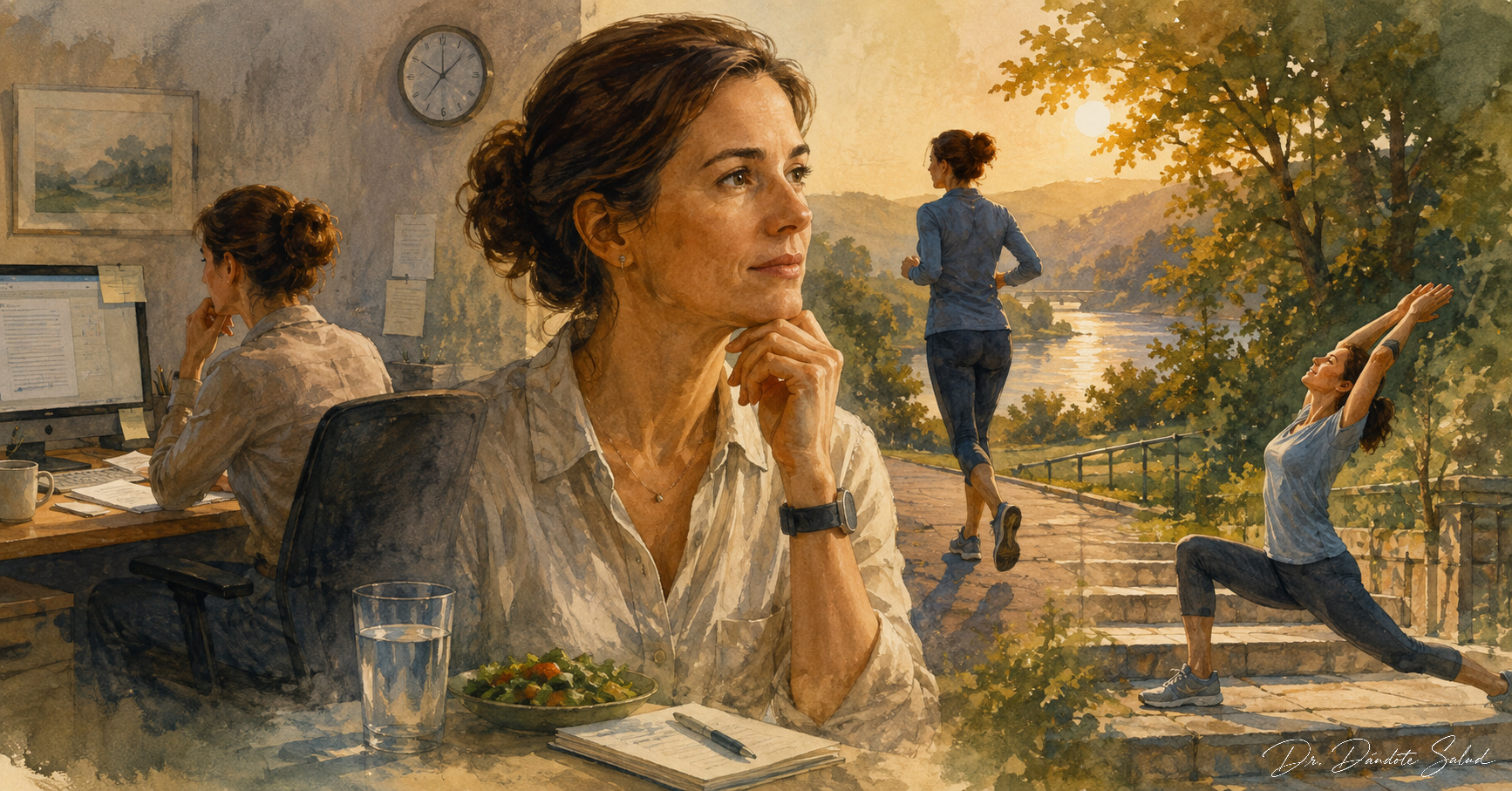
How to strengthen your bones through the way you live
When we talk about bone health, I’m not just talking about bones.
I’m talking about your mobility, your independence, and how you live each day.
Osteopenia is a moderate decrease in bone mineral density.
Osteoporosis is a more marked loss that raises the risk of fractures, especially in the spine, hip, and wrist.
Behind those words are “silly” falls that end in the ER, the fear of moving, and a quality of life that shrinks if we don’t act in time.
The good news is that lifestyle really does matter—and it’s essential, especially where medications are hard to access. From what you eat to how you move and rest, there are daily decisions that strengthen your bones and help prevent falls.
The essentials you can start today
As a physician, when I walk this path with you in the clinic, I start from six pillars that work together:
1. Plant-based, whole-food nutrition
Make vegetables, fruits, legumes, whole grains, nuts, and seeds the base of your plate.
Get enough calcium from food:
- Dairy and fermented dairy (yogurt, kefir)
- Fortified plant milks
- Calcium-set tofu
- Sardines with bones
- Leafy greens
- Sesame seeds and almonds
Support vitamin D with sensible sun exposure and foods like eggs and fatty fish. Supplements are considered case by case, depending on your levels and risk.
2. Regular physical activity
Bones respond to mechanical stimulus.
The most effective combination is:
- Strength training
- Aerobic activity with some impact
- Balance work
Three days a week of strength training makes a real difference. Walking is healthy, but by itself it barely slows bone loss.
3. Restorative sleep
Sleeping 7–8 hours helps your muscles, your balance, and your bone metabolism.
4. Stress management
Conscious breathing, brief meditation, walks in green spaces, and calming routines. Chronically high cortisol is not a friend of your bones.
5. Avoiding risky substances
Don’t smoke.
Limit alcohol.
Both decisions protect your bone mass.
6. Positive social connection
Group programs improve adherence to exercise and reduce isolation—a factor that’s also linked to more falls.
In countries and settings with fewer resources, these same measures are the foundation: community education, safe sun exposure, including local foods rich in calcium and protein, and promoting daily movement adapted to the reality of each neighborhood.
How to eat to strengthen your bones
- Daily calcium: aim for about 1,000–1,200 mg per day from real food.
Spread your calcium sources throughout the day to improve absorption. - Vitamin D: prioritize smart sun exposure and foods; individualize supplements based on blood levels and risk.
- Protein: repairs muscle and supports bone. Include plant proteins and, if you use them, fermented dairy or fish.
- Mediterranean-style pattern: more vegetables, fruit, legumes, whole grains, olive oil, and fish. This pattern is associated with better bone health and fewer fractures.
- Hydration: don’t forget it. Dehydration worsens balance and increases fall risk.
The kind of exercise that best protects your bones
I summarize it the same way I do in clinic:
moderate strength training three times per week, plus aerobic activity with tolerable impact and balance work.
Strength (resistance) training
For the lumbar spine and hip, the most effective intensity is moderate, for example around 70% of your 1RM, with:
- 2–3 sets of 6–12 repetitions
- 3 days per week
- For up to 12 months or more
If you don’t use weights yet, start with body weight and resistance bands.
Impact and weight-bearing
Climbing stairs, small jumps, brisk walking, or gentle jogging when it’s safe.
This especially stimulates the femoral neck and tibia.
If you’ve had prior vertebral fractures or are very frail, avoid jumping and keep impact low.
Balance, posture, and motor control
Tai Chi, single-leg balance exercises, sitting and standing from a chair without using your hands, and back extensor work.
These reduce falls and improve function.
Mind–body practices
Tai Chi and yoga add postural control, flexibility, and confidence. Their effect on bone density is modest, but they improve safety and adherence—which is essential.
What if I already have severe osteoporosis or previous fractures?
Exercise is still a pillar. It just needs to be individualized and supervised, especially at the beginning.
- Avoid repeated, fast, or heavily loaded flexion and rotation of the spine, and any extreme range of motion that causes pain.
- In very frail people, I start with lower intensities, shorter sessions, and focus on back extension, functional strength, and balance.
Physical therapy supervision helps you progress safely.
A simple, accessible weekly program
Before starting, review your plan with your health care team and learn basic technique.
Strength – 2–3 times per week
Examples:
- Chair squats
- Row with resistance band
- Heel raises
- Shoulder press with a water bottle or band
- Wall push-ups
Do 2–3 sets of 8–12 repetitions. Progress gradually.
Balance and functional work – 2–3 times per week
- Walk in a straight line
- Stand up from a chair without using your hands
- Single-leg balance for 10–30 seconds
- Side stepping
Repeat each 5–10 times.
Aerobic and moderate impact – 150 minutes per week
- Brisk walking
- Dancing
- Climbing stairs
Add small jumps only if there’s no pain and no prior fractures, and your team says it’s safe.
Posture and back extension – daily
- Bird-dog
- Gentle prone back extensions
- Deep breathing with upright posture
Hold 5–10 seconds, repeat about 10 times.
Example week:
- Monday: strength + balance + posture
- Tuesday: aerobic + posture
- Wednesday: strength + balance + posture
- Thursday: aerobic + posture
- Friday: strength + balance + posture
- Saturday: aerobic + posture
- Sunday: gentle walk and stretching
What recent research adds
In severe osteoporosis and prior fractures, supervised programs are safe and effective.
Progressive supervised strength training is the intervention with the strongest evidence to improve:
- Bone mineral density (BMD)
- Physical function
- Pain
- Quality of life
Tai Chi and Pilates are safe and useful as complements, but have less evidence for fracture prevention.
Key safety messages:
- Avoid fast or heavily loaded spinal flexion and rotation, especially with prior vertebral fractures.
- Start with guided technique and gradual progression through physical therapy when risk is high.
We still have gaps regarding very long-term effects and optimal protocols in men and in the very frail, but the practical message doesn’t change:
Moderate, well-prescribed strength training, consistency, and initial supervision when possible.
Safety first
- If a movement hurts, lower the load or modify the exercise. Talk to your doctor.
- Avoid sudden, jerky spinal flexion and rotation, especially with added weight.
- Use stable footwear, declutter your home to reduce tripping hazards, and have your vision and hearing checked.
- Stay hydrated and eat enough. A muscle that’s low on energy gets tired faster—and that makes you unstable.
Tests and follow-up
Bone density scanning (DXA) is the standard tool to diagnose and monitor osteoporosis.
If you’ve already had a fragility fracture, the diagnosis of osteoporosis is essentially made. We use DXA to quantify damage and track response to your plan.
In places with limited access to DXA, we use clinical risk calculators and prioritize testing for those with the highest fracture risk.
What research adds here
Tools like FRAX let us estimate fracture risk with or without BMD, which is very useful where DXA is not readily available.
Reporting the 10-year absolute fracture risk helps us tailor treatment and avoid overprescribing medications in people with low or moderate risk.
In older men, repeating DXA routinely adds very little fracture prediction value beyond the baseline scan if risk factors and treatment haven’t changed.
Medications: key nuances from the evidence
Even though this article focuses on lifestyle, many readers ask about medications. Two practical messages:
- Starting bisphosphonates shortly after a fracture is not associated with impaired healing in large datasets.
- The time to benefit matters when we set expectations: roughly 1 year to prevent 1 nonvertebral fracture per 100 women treated.
Rare adverse effects are important too:
- Medication-related osteonecrosis of the jaw is rare but real. It’s important to recognize it and coordinate with dental care if you use antiresorptives for many years.
Observational data suggest that denosumab may be associated with lower incidence of type 2 diabetes than bisphosphonates, especially in people with prediabetes. It’s an interesting signal, but not enough on its own to choose one drug over another.
When there’s no access to medications
The core strategy doesn’t change:
- Community education
- Local foods rich in calcium and protein
- Safe sun exposure
- Body-weight strength exercises
- Taking the stairs instead of the elevator
- Walking groups and Tai Chi in community spaces
- Safe places to move
What matters most is adherence: small changes, sustained over time.
What the WHO prioritizes in lower-resource settings
- Validating and using FRAX or other risk calculators in local populations
- Non-pharmacologic prevention adapted to culture and resources:
education, calcium- and vitamin D–rich diets, safe sun exposure, physical activity, and fall prevention - National guidelines based on evidence, fracture registries, and food fortification when appropriate
- Strong primary care and multidisciplinary teams to identify, treat, and follow people at risk
What I want you to take home
Your bones respond to stimulus and to nutrients.
- Strength + aerobic work with tolerable impact + balance, three days a week is the winning combination.
- Eat a whole-food, predominantly plant-based diet, rich in calcium, vitamin D, high-quality protein, fruits, and vegetables, and low in sodium, sugars, and ultra-processed foods.
- Sleep, manage stress, don’t smoke, limit alcohol, and nurture your relationships.
- Prevent falls: check vision and hearing, wear stable shoes, organize your home, use handrails, and keep good lighting.
The most important thing is to start today—and continue tomorrow.
Important notice
This article is for information only. It does not replace a medical visit. Every case requires an individual assessment of risk factors and other health conditions.
There are situations that completely change the recommendation, such as:
- History of kidney stones when deciding on calcium and vitamin D
- Chronic kidney disease
- Hyperparathyroidism
- Long-term glucocorticoid use
- Previous fractures or frequent falls
Always talk with your health care team before starting, changing, or stopping supplements, exercise programs, or treatments.
🌍 This article is also available in Spanish. Please use the language switcher in the top menu.
Sources
Bruyère O, Scott D, Papaioannou A, et al. The impact of sedentary behavior and physical activity on bone health: A narrative review from the Rehabilitation Working Group of the International Osteoporosis Foundation. Calcif Tissue Int. 2025;116(1):109. doi:10.1007/s00223-025-01421-6.
Faienza MF, Lassandro G, Chiarito M, et al. How physical activity across the lifespan can reduce the impact of bone ageing: A literature review. Int J Environ Res Public Health. 2020;17(6):E1862. doi:10.3390/ijerph17061862.
School health guidelines to promote healthy eating and physical activity. MMWR Recomm Rep. 2011;60(RR-5):1-76.
Wilsgaard T, Emaus N, Ahmed LA, et al. Lifestyle impact on lifetime bone loss in women and men: The Tromsø Study. Am J Epidemiol. 2009;169(7):877-886. doi:10.1093/aje/kwn407.
Wilson-Barnes SL, Lanham-New SA, Lambert H. Modifiable risk factors for bone health & fragility fractures. Best Pract Res Clin Rheumatol. 2022;36(3):101758. doi:10.1016/j.berh.2022.101758.
Zhu K, Prince RL. Lifestyle and osteoporosis. Curr Osteoporos Rep. 2015;13(1):52-59. doi:10.1007/s11914-014-0248-6.
Kopiczko A. Determinants of bone health in adults Polish women: The influence of physical activity, nutrition, sun exposure and biological factors. PLoS One. 2020;15(9):e0238127. doi:10.1371/journal.pone.0238127.
Reid IR. Bone-friendly lifestyle and the role of calcium or vitamin D supplementation. Climacteric.2022;25(1):37-42. doi:10.1080/13697137.2021.1939296.
Walker MD, Shane E. Postmenopausal osteoporosis. N Engl J Med. 2023;389(21):1979-1991. doi:10.1056/NEJMcp2307353.
Ishimi Y. Osteoporosis and lifestyle. J Nutr Sci Vitaminol (Tokyo). 2015;61(Suppl):S139-S141. doi:10.3177/jnsv.61.S139.
Sheng B, Li X, Nussler AK, Zhu S. The relationship between healthy lifestyles and bone health: A narrative review. Medicine (Baltimore). 2021;100(8):e24684. doi:10.1097/MD.0000000000024684.
Morin SN, Leslie WD, Schousboe JT. Osteoporosis. JAMA. 2025;2835762. doi:10.1001/jama.2025.6003.
Discover more from Dr. Dándote Salud
Subscribe to get the latest posts sent to your email.

Related Posts

The Family Bonds That May Stay With Us for Life
Recovery Is Health: How to Mentally Unplug After Work